
Rylan Clark speaking during ITV’s This Morning on 27 August 2025, where his comments on immigration sparked widespread debate and divided reaction across social media. Image: Manchester Evening News
By James Murray-Hodcroft
13th September 2025
We live in an age where listening has become a lost art. Words are pounced upon, clipped into soundbites, and hurled back with outrage or applause — depending not on what was said, but on who said it and how it can be weaponised. The recent controversy surrounding Rylan Clark is a stark reminder of how easily we fall into this trap.
On 27 August 2025, Clark became the latest political casualty in Britain’s culture war after addressing a widespread concern: illegal immigration. His comments on This Morning were seized upon immediately, with The Metro running the headline: “Rylan Clark’s immigration rant on This Morning was wrong – and dangerous.” Others rushed to champion him as a truth-teller. Neither response showed much evidence of real listening.
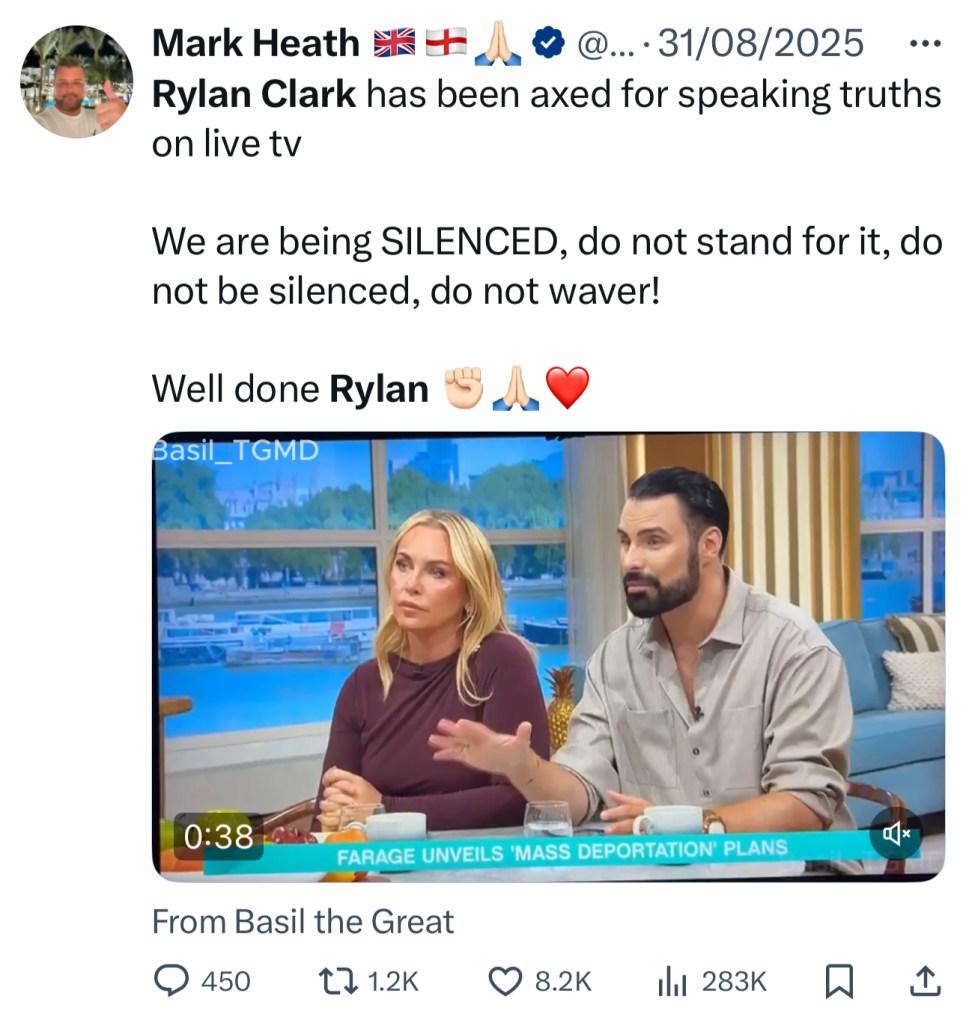
A social media post claiming Rylan Clark was “axed for speaking truths” after comments on immigration during ITV’s This Morning, 31 August 2025. The broadcaster has not confirmed any such dismissal, but the clip has fuelled heated debate online. Image: X.com

A social media post praising Rylan Clark and presenter Laura Wood for “breaking the mould” following Clark’s comments on immigration during ITV’s This Morning. The post suggested the pair were more in touch with public opinion than other celebrities. Image: X.com
What did he actually say? In the middle of his passionate monologue, Clark broke away and inserted one crucial phrase: “this is the narrative we’re being fed.” That is the heart of the matter. He wasn’t saying the stories about hotels, iPads, and three meals a day were necessarily true. He was saying that he finds it “insane” if they are
This distinction matters. Clark was not laying down facts; he was repeating claims that many people have heard and, rightly or wrongly, believe. His point was not about asylum seekers themselves, but about the narratives shaping public perception; narratives that fuel division and anxiety.
When we fail to hear that nuance, we fall into the trap of reflexive politics. The “Left” condemns, the “Right” applauds, and the middle ground is erased. Clark’s comments illustrate how immigration, asylum, and illegal entry have been conflated into one messy, emotional debate; not just by politicians, but by those who profit from keeping us angry and afraid.
Now, let’s test Clark’s recited claims against the evidence:
Claim vs Fact-Check: Common Immigration Claims
Claim: “Asylum seekers in hotels are given iPhones or Samsungs when they arrive, paid for by taxpayers.”
Fact-Check: Not generally true. Asylum support from the Home Office does not include giving new mobile phones to people. Some charities donate second-hand phones, and in some cases accommodation includes means to communicate, but government does not provide new phones.
Source: Full Fact
Claim: “They receive £70 a week in addition to meals.”
Fact-Check: False or misleading. The support rates are lower: those in catered accommodation (where meals are provided) receive £9.95 per week. For those without meals provided, the payment is £49.18 per week. Neither situation includes the £70 figure.
Source: Full Fact
Claim: “Hotels housing asylum seekers are always luxurious or four-star.”
Fact-Check: Misleading. Some hotels used have had four stars, but many are not. The Home Office uses a variety of accommodation types—flats, hostels, shared housing as well as hotels depending on capacity and demand.
Source: Full Fact
Claim: “Asylum seekers are getting private healthcare or special private treatment paid by taxpayers.”
Fact-Check: Incorrect. Asylum seekers have access to publicly funded healthcare (NHS), not private paid-for healthcare as a general benefit. Some care may be delivered by independent providers, but under public funding.
Source: Reuters
Claim: “Use of hotels to house asylum seekers is permanent.”
Fact-Check: Not accurate. The Home Office states that hotels are a temporary measure due to shortages of other accommodation. Many asylum seekers are housed in hotels temporarily before being moved to more permanent accommodation.
Source: Independent
Claim: “There has been a significant rise in arrivals via small boats / irregular routes.”
Fact-Check: Supported by data. Between 2018 and mid-2025, around 168,000 people arrived via small boats, making up about 30% of asylum claims in that period.
Source: House of Commons Library
Once you strip away the noise, the real question is whether Clark deserved the level of backlash he received. The answer is no. He deserved scrutiny, yes — but not to be pushed into the arms of the very people weaponising his words. By rejecting him outright, those on the Left may have nudged him closer to the Right, simply for daring to point out a truth: we are all being fed a narrative designed to make us feel unsafe.
The tragedy is not that Clark spoke out, but that we, as a society, didn’t really hear him. Instead of listening, we filtered his words through the prisms of outrage and loyalty. And in doing so, we missed the opportunity to challenge the narrative together.
If we want progress, we must remember how to listen; even when we don’t like what we hear.
What do you think… are we reacting to the narratives we’re fed, rather than the facts themselves? Share your thoughts in the comments below.
 The Hodlines: Investigative Journalism